New Polling Shows Parents Are Ready for the Education Freedom Tax Credit

March 16, 2026

Momentum continues to build around the new federal Education Freedom Tax Credit, and recent national polling confirms something advocates have long believed: parents understand the value of educational opportunity—and they are ready to support it.


New research from EdChoice found strong awareness and support for the federal tax credit among K–12 parents. In fact, parents are significantly more engaged with the policy than the general public, signaling that families who experience education firsthand recognize the potential impact of scholarship programs.


Parents Are Paying Attention

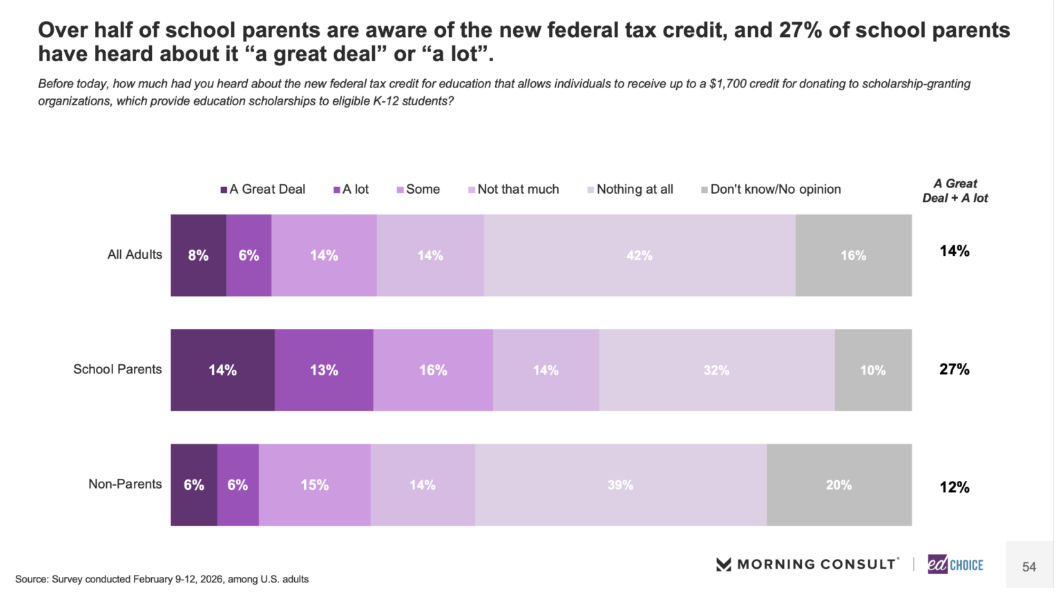
One of the most striking findings from the survey is that K–12 parents are simply more aware of the policy. According to the polling, 27% of school parents say they have heard “a lot” or “a great deal” about the federal tax credit, nearly double the share of adults overall who say the same.


Strong Support from Families


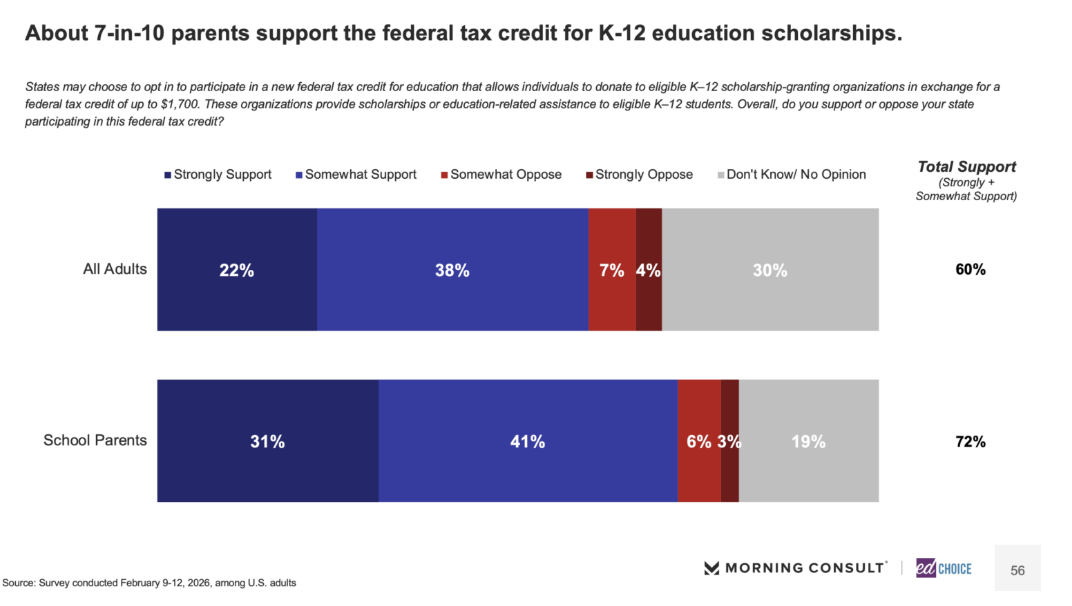
The polling also found nearly three-fourths (72%) of school parents support the federal tax credit for K–12 scholarships, including about one-third who say they strongly support it.


This level of support reflects a growing national consensus that families should have more flexibility when it comes to their child’s education. Parents want options that fit their child’s needs—whether that means a private school, specialized tutoring, or other learning opportunities.


Scholarship programs funded through tax-credit donations help make those options possible, particularly for families who might not otherwise be able to afford them.
Parents Are Also Ready to Give


Perhaps the most encouraging finding for scholarship organizations is that parents are not just supportive, they are willing to participate.


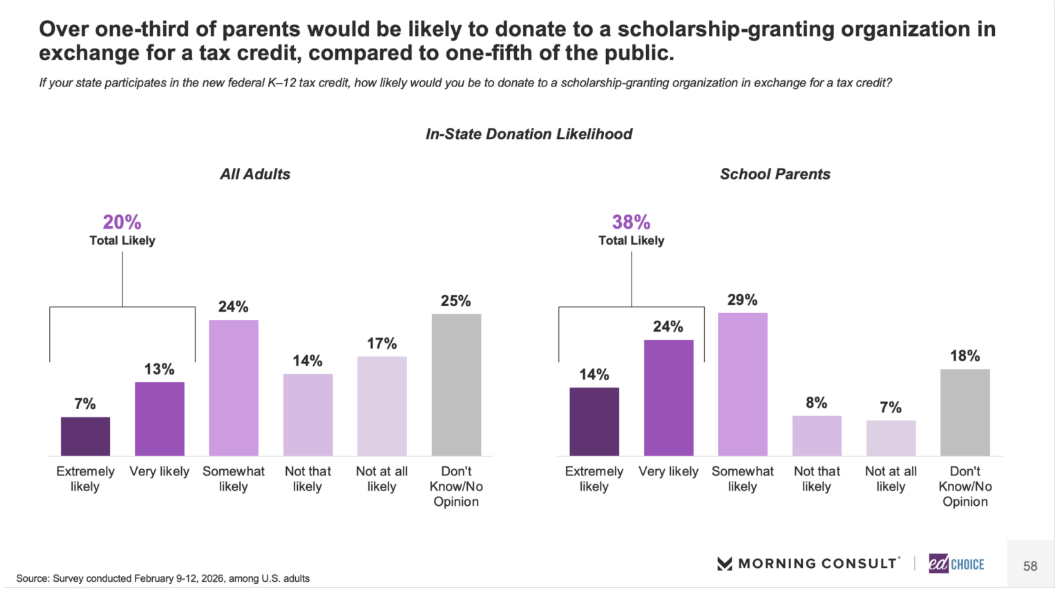
The EdChoice survey found 38% of school parents say they are “extremely” or “very” likely to donate to a scholarship granting organization if their state participates in the tax credit program.


That level of potential participation highlights something powerful: parents do not simply want educational freedom for their own children, they want to help make it possible for other families as well.
What This Means for Alabama


Alabama has already said yes to this national opportunity. In January 2026, Governor Kay Ivey signed an executive order committing our state to participate in the Federal Education Freedom Tax Credit program. That means Alabama students and families will be able to benefit from this new law starting in 2027.


This federal credit doesn’t replace state tax-credit scholarships like the one AOSF administers now, it adds another powerful tool to the education freedom toolkit. It allows donors to support scholarships above and beyond state programs, amplifying impact without extra cost.


In practical terms, that means donors will be able to support scholarships above and beyond existing state programs, amplifying the number of students who can benefit—without creating additional financial burden for taxpayers.


For families across Alabama, that combination of state and federal opportunity has the potential to expand access to schools and learning environments that best meet their children’s needs. And if the latest national polling is any indication, parents are not only supportive of these opportunities—they are ready to help make them possible.

March 2, 2026
For decades, AOSF has put parents — not systems — in the driver’s seat when it comes to their children’s education. We know one size doesn’t fit all. That’s why the new federal Education Freedom Tax Credit (a.k.a. federal scholarship tax credit) is a big deal: it lets everyday taxpayers redirect part of what they already owe in federal taxes to directly fund K-12 scholarships for Alabama students. Here’s the practical version of how it works, and why it matters.
February 24, 2026
When you give to support K–12 scholarships, not all tax incentives are created equal — and knowing the difference can help make your gift go further.
February 19, 2026
When donors give to the Alabama Opportunity Scholarship Fund, they’re not just funding tuition. They’re opening doors to schools like Faith Academy in Mobile — places where students are known, supported, challenged, and grounded in faith. Faith Academy is a private Christian school committed to developing the whole child: academically, spiritually, and personally. Excellence isn’t just a tagline there. It’s woven into the classroom, the stage, the football field, and the daily rhythms of school life. And for many families, access to that kind of education is only possible because of scholarship support.
February 16, 2026
What Is the Education Freedom Tax Credit? The Education Freedom Tax Credit (EFTC) is a federal tax credit that lets Alabama taxpayers reduce their federal income tax liability by donating to a qualified Scholarship Granting Organization (SGO) like the Alabama Opportunity Scholarship Fund. When you give, you get a dollar-for-dollar federal tax credit, not just a deduction, for your contribution. Key benefit: Donate up to $1,700 per individual and cut your federal tax bill by the exact same amount. This makes the EFTC one of the most impactful tools for supporting school choice and education scholarships in Alabama.
February 11, 2026
Big changes are coming to school choice and Alabama families stand to benefit in a major way. The new Education Freedom Tax Credit , launching in 2027, creates a federal tax credit for people who donate to scholarship-granting organizations like the Alabama Opportunity Scholarship Fund (AOSF) . Translation: taxpayers can redirect part of their federal tax bill to fund K–12 scholarships for students right here in Alabama. This isn’t a policy talking point. It’s a real, practical opportunity to expand educational access for families who need options. Let’s break it down.
January 31, 2026
Sherri Rowton, Development Director, shares why she supports school choice for all Alabama families. I was fortunate to grow up in a family where education was always a top priority. My mother was a first-generation college graduate who spent her career as an elementary school teacher. My father overcame a difficult childhood by enlisting in the military, where he earned a bachelor’s degree and two graduate degrees. From an early age, I saw how education can open doors and change the trajectory of a life. I later spent two decades as a fundraiser for Auburn University, where I witnessed firsthand the transformative power of education. Our generous donors gave so that others could earn an education—something no one could ever take away from them. But that foundation must begin well before college, equipping students for lives in which they, and their families, can truly flourish. That is why Alabama Opportunity Scholarship Fund is so invaluable. Through the generosity of our supporters, we empower parents to choose the school and learning environment that best fits the needs of their children—whether public, private, homeschool, or microschools. My own family experienced the difference the right school can have. Our local public school provided my older son with exactly what he needed to succeed; he is now a college graduate with a full-time career. My younger son, however, needed an environment with more structure than his school could provide. We were able to find a setting that better met his needs, and he is now a college senior—an outcome I sincerely doubt would have been possible without that change. It is my honor and privilege to work alongside such generous donors who make opportunities like these possible for families across Alabama. Education freedom is truly a win-win for families, for our donors, and for the future of our state.
January 30, 2026
Meet Tonya Jones, our Implementation & Operations Manager, and learn why school choice matters to her and to families across Alabama.
January 29, 2026
Meet Casandra Meguiar, our Development Manager, learn why school choice matters to her families and to families across Alabama.
January 28, 2026
Meet the people behind our work and discover why school choice matters—through personal stories of opportunity, access, and impact.
January 27, 2026
Meet the people behind our work and discover why school choice matters—through personal stories of opportunity, access, and impact.